Friday, October 11, 2013

New member of the team!


The day has come for you to meet one of the new members of the Herbarium family! My name is Heather, and I joined Dr. Monfils and the rest of the team to begin working on my Master’s in May, and since then have been learning all new and exciting information, along with taking two classes this semester, Wetland Plants and Molecular Ecology.

But let’s start with a little background.  I was born at a very young age (about 0), and grew up in Maine, which is where I still call home base.  I enjoyed travelling, warmth, and the coastline, so I moved to Florida where I spent four years completing my undergraduate degree in Biology with a concentration in Marine Biology.  While there, I received a botany scholarship and as a requirement, completed my senior research project in a botanical subject area (seaweed counts, right?). Once I had my fill of the warm weather, I moved back up north to Boston, where I began my career working in the biological sciences.

I was fortunate enough to land a job in my field (albeit part time) shortly after graduation, and at an aquarium that I had always dreamed of working for. I worked for roughly a year with them as an educator, talking to people both in the Aquarium and in schools about ocean life.  To gain more skills, I happily volunteered there once a week as an aquarist.  
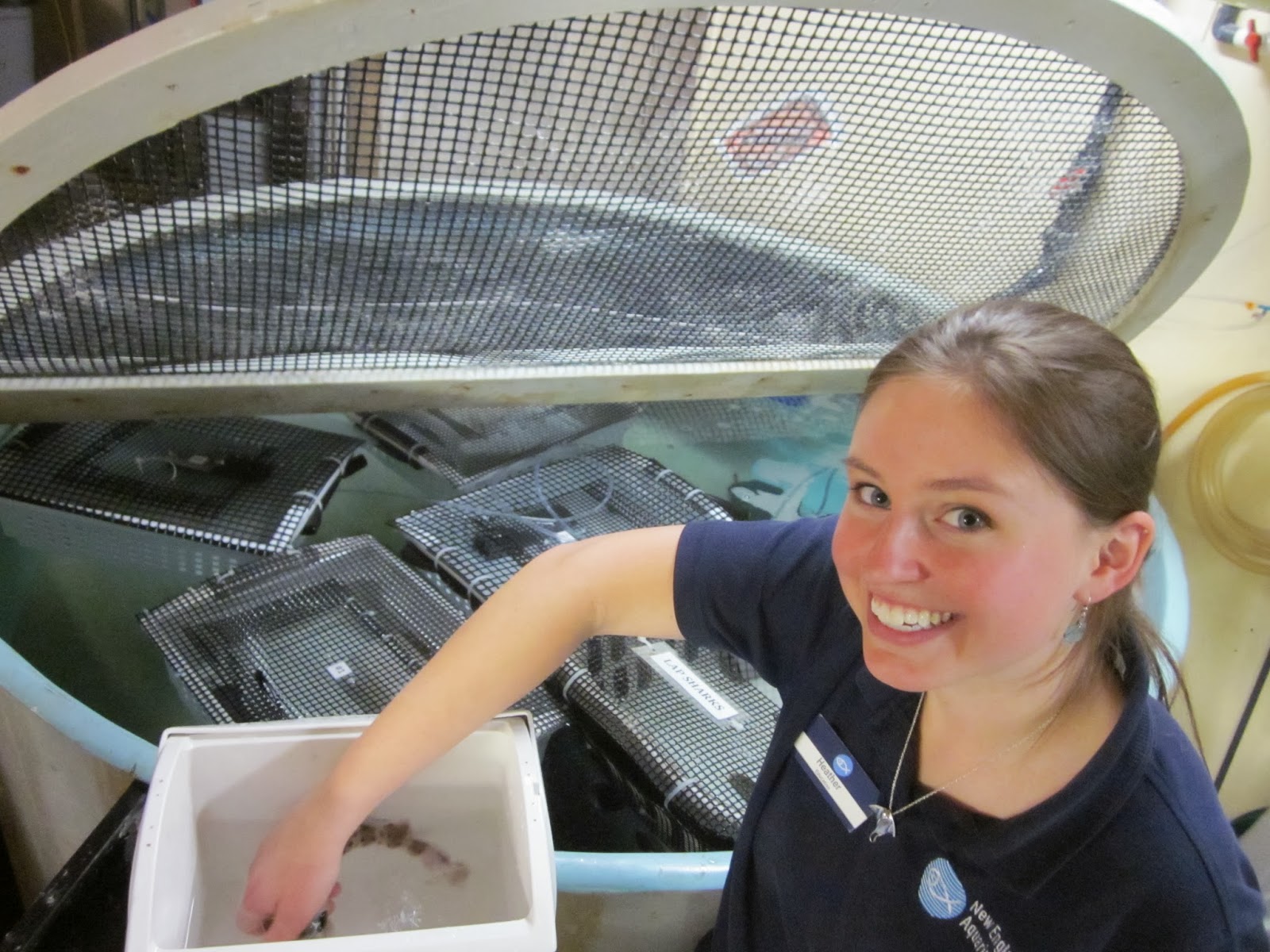
Getting a juvenile epaulette shark (Hemiscyllium ocellatum)
from the shark nursery ready for a live animal presentation 

Large exhibits require a little more dedication in
cleaning than your average home fish tank
Seeing as how I enjoyed variety, I also worked two days a week at a (warm) butterfly garden at a museum, where I educated visitors about butterflies, cared for the plants, and gained more botanical skills to add to those that I already had.
The atlas moth (Attacus atlas) is the world's largest moth!

After nearly a year of working sometimes 7 days a week and barely scraping by in the busy city, I decided to spend some of the best six months of my life as a full time seal pup rescue and rehab volunteer at a little seal sanctuary in the quiet northwest corner of Ireland. While involved with marine mammals, I flew over to the Moray Firth in Scotland for 10 days to volunteer with a cetacean research and rescue group and learn some practical field research skills.  After those fantastic 10 days, I knew for a fact that even though I loved education, horticulture, and animal husbandry, I loved research best of all and contributing to the world’s scientific knowledge.
A bottlenose dolphin (Tursiops truncatus) mother and her very young calf


Rescuing a premature grey seal (Halochoerus grypus)
from the beach on a typical Irish summer day

So here I am, working with plants again! As I wanted to get more involved with wetland and freshwater ecosystem plant life, what better place to go next than Michigan. Since many of the biological jobs I applied to in the past (and believe me, there were a plethora of them) required molecular lab skills, I wanted to focus on that area in while obtaining my degree.  When an exciting opportunity presented itself to me, I joined Dr. Monfils in her plant systematics research with the Cyperaceae.  We will have to see what the next couple of years will bring, but I can tell you now that I am already enjoying myself immensely and am looking forward to working as part of this team in the CMC herbarium and plant systematics lab. 

Schoenoplectus americanus, present at the salt marsh we visited in the Wetland Plants class

Sláinte!

~ Heather

Tuesday, October 1, 2013

A New Term and New Tasks

After I left for my study abroad trip in July, Abigail fulfilled our goal of digitizing the entire Herbarium collection. The long hours we put into completing that task and the number of books on tape we listened to while bar-coding are innumerable.

Now we have a new task, Foldering, and Abigail has gone and graduated, leaving me to complete this myself.

The process is simple: All of the specimens will be placed within two folders, one, a thick, protective folder that has a typed label stating the Family and Genus, the other a thin folder labeled with the species name.

This task is not nearly as slow as Digitization, a process which required the handling of each individual specimen in the collection, but for accuracy's sake the names in our completed database are being run through iPlantCollaborative.org and Tropicos.org again. This takes some time to do but is necessary to ensure that what species we have in the cabinets matches what species we have in the database, and to again verify the specimens' names.

Running the species names also sheds light on who named the species, information we want to include in the labels we print for the folders. 

With my graduation date coming up soon, my efforts in getting an informational poster and pamphlet for the Herbarium have doubled. The content of these needs to be edited and approved by Dr. Monfils by mid-October, after which I will work with a few departments on campus to get them formatted and printed before December.

I also have been given the honor of working closely with Hillary. Hillary is currently taking the Wetland Plants course with Dr. Monfils and helps Rachel with her research.
Hillary's plant identification skills are far superior to mine and her botanical knowledge has been extremely helpful over the past few weeks. Her keen understanding of plants assures me that I will be leaving the Herbarium in good hands.

Still, there are a few key tasks that are essential to the running of the Herbarium that I must show Hillary. We will be going, step by step, through the tasks that are important to processing incoming material. Along the way, we will be testing the accuracy and the clarity of the protocols that have been written for each of these steps.

The itinerary for Herbarium training:
Drying and Freezing, Mounting, Digitizing, Updating the Database, and Filing. 

Together we also have the goal of Foldering the entire collection by the end of the summer. 

We are geared up for quite a busy semester!

Peace. Love. Plants.
Sascha

Friday, July 26, 2013

The Completion of Digitization!


It’s been a long haul, but the day has finally come: digitization of the CMC Herbarium is fully complete! I am glad that I was here to see the end of this massive project, but there were many who came before me who made this possible. Thanks must go out to Dr. Monfils, Michael Giddens of SilverImage technology, Adriane, Emilie, Sascha, David, Heather, and everyone else who has worked tirelessly so that we could reach this point. It feels good to be done, albeit surreal, and it will feel even better once all of the high-resolution photos are pushed onto the online database for everyone to enjoy and use. I hope that the CMC Herbarium’s efforts will in turn aid the research and learning at other Universities and Herbaria, big and small.

It’s been too long since I blogged, so beyond the epic completion of digitization, much has happened. A few weeks ago myself, Heather, David, and some of CMU’s BUMP students volunteered to help the Chippewa Nature Center with their annual Chippewa River cleanup. It was fun racing each other in our canoes to see who could spot and pick up the most garbage—and it was shocking not only how many tires we found (about six!), but also how many tires one canoe can hold without missing a beat. In addition to the river cleanup, I found this epically cool Boxelder (now Acer negundo var. negundo L.) from 1878. Look at that beautiful handwriting!


 "Sapindaceae, Soapberry Family. Negundo aceroides. Ash-leaved Maple, or Box Elder."

"By Father Pierce's side gate. 1878 Ypsilanti Mich."

I also created a “Master List of Species” spreadsheet based on our pre-organization databases. Now we have a (mostly) accurate estimate of how many of each species are in our collection. In addition, there were four shelves of “Ask Anna” specimens to contend with. These were specimens that had strange problems, and so had been pulled during the organization process to be dealt with at a later date. They had such maladies as multiple accession numbers, no collection data, or sometimes no specimen attached to the mounting at all. There was also what was clearly a mullein but had been identified as a skunk cabbage. I still haven’t figured that one out. One by one I figured out how to fix what I could on my own, and consulted with Anna concerning the rest. I then accessioned, name verified, annotated, databased, barcoded, digitized, organized, and filed them with their brother and sister specimens. I have also finished writing and compiling a detailed binder of CMC Herbarium protocols, which Sascha had begun before leaving for her adventures in England.

Hillary and Rachel trying to get work done amongst the carnage of "Ask Anna" specimens

Finally, I have been working mostly on aesthetics. I myself am not trained in mounting, so I have begun making the Herbarium look pretty and organized. This includes proper cabinet labels (goodbye sticky notes…you have served us well!), detailed cabinet contents sheets, and most importantly, replacing the old, scribbly specimen folders with dual-layered, properly labeled genus and species folders. I will also be double-checking organization as I go. Hopefully soon we will be getting fancy internal shelf labels. For now, the faithful sticky notes and the outer cabinet content sheets will have to do.

 My attempts to neaten up the Herbarium labels. Unfortunately I'm still working on devising a way to prevent wrinkling. They also start out perfectly flat when I put them up and somehow attempt contortions over time...


Until next we rendezvous through words,
Abigail H.

Monday, July 8, 2013

Bringing AmeriCorps into the Field

Hillary and I have been working long, hot days in the field for seven weeks, but we weren’t always alone this season. For several days we had an AmeriCorps member join us in the prairie fens, learning about plants and wetlands.

Pictured from left to right: Hillary Karbowski, Patrick Bower, Rachel Hackett, Alan Richardson, and Molly Gorman. 

AmeriCorps is a national service program founded in 1994. AmeriCorps members volunteer their time to prove a service to a local community in exchange for training, networking, an education award for further education and student loans, and the feeling of impact and accomplishment that stays with you for a lifetime. I was an AmeriCorps member from 2006 to 2008 in a State program sponsored by the Michigan Department of Agriculture.

These AmeriCorps members were from an AmeriCorps National Civilian Community Corps (NCCC) team. AmeriCorps NCCC is a full-time, team-based program where members from across the country commit one year to travel to 4 different locations, meeting a different service need in each community. Hillary and I met the team at The Nature Conservancy’s Nancy E. Hand Field Station. The Nature Conservancy (TNC) was their second service commitment. Their main duty was to manage invasive species, but they also joined eastern massasauga rattlesnake (Sistrurus catenatus catenatus) surveys, TNC community service days, local habitat for humanity, and the local humane society among other organizations.

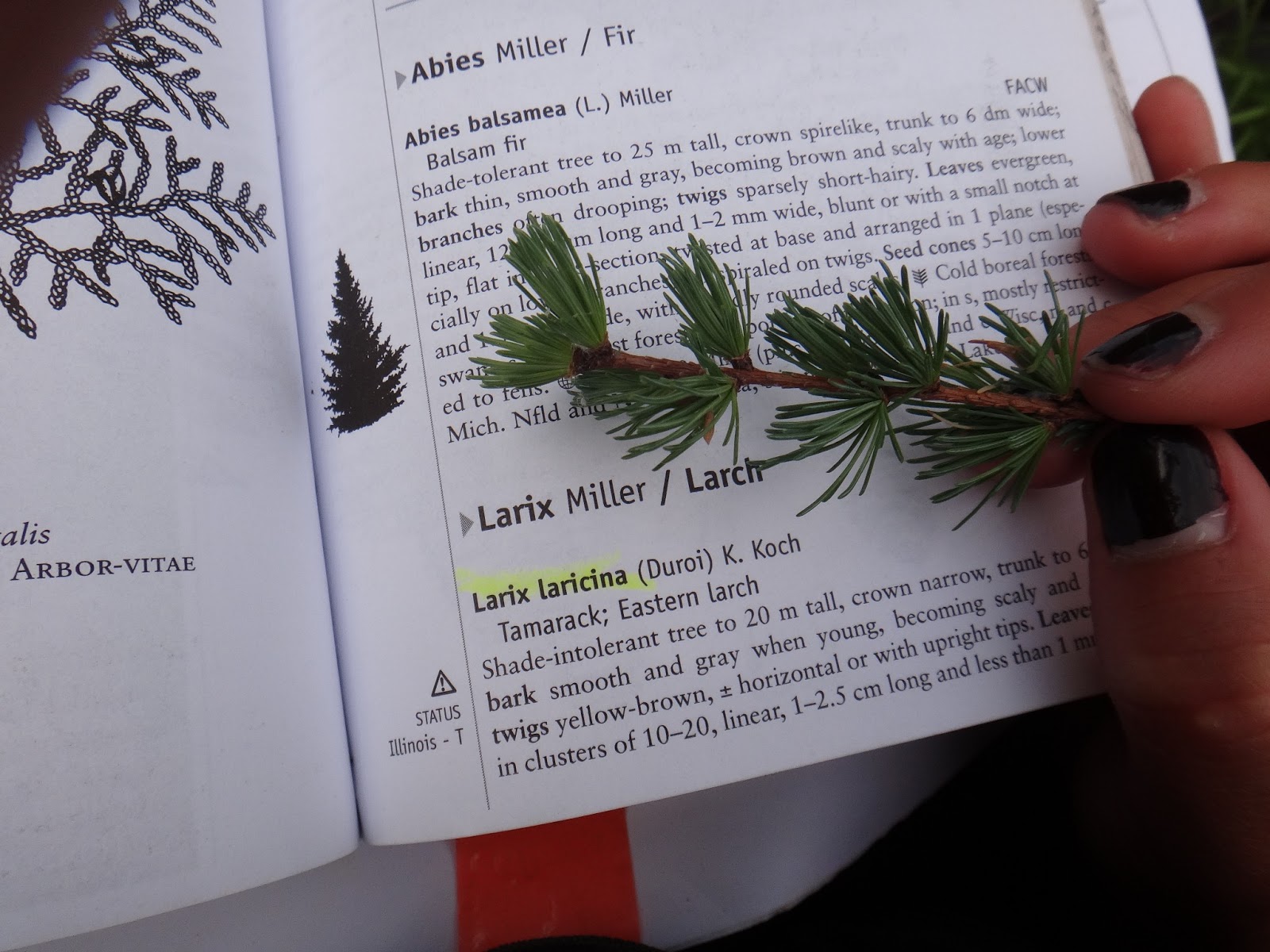
When Hillary and I arrived, we explained our project to the team and three members were interested in joining us when we were sampling on TNC managed properties. They were able to put down their backpack sprayers and brush cutters and donned their rain gear. We shared with them the basics of plant identification, major plant families of prairie fens, and the ins and outs of specimen collection. We even set them down with a few flowering plants and a dichotomous key.

Larix larcina: correctly identified using a dichotomous key by AmeriCorps member Molly  Gorman. 

We did have a few adventures. With Patrick Bower we finished up surveying the diverse Ives Road Fen in Tecumseh, MI. This was one of the properties the AmeriCorps had been managing for glossy buckthorn (Frangula alnus) and reed canary grass (Phalaris arundacea)

A panoramic view of Ives Road Fen in Tecumseh, Michigan. 

With Molly Gorman we got an up and close look at a recent burn on a privately owned prairie fen, and flowering pitcher plants (Sarracenia purpurea), and valerian (Valeriana uliginosa).

The aftermath of a previously burned prairie fen.

A closer look at a flowering  Sarracenia purpurea (pitcher plant). 

An up close view of a flowering Valeriana uliginosa (valerian). 

And with Alan Richardson we set our transect next to a 6 -7 year old eastern massasauga rattlesnake, Sphagnum spp. mounds covered in round-leaf sundews (Drosera rotundifolia), and bladderworts on deer trails (Utricularia spp.).

An eastern massasauga rattlesnake. Photo credit to:  Joseph Sage.

Spagnum spp. mounds with a population of Drosera rotundifolia (round-leaved sundews)  atop of it. 

Utricularia spp. (bladderworts)  found on a deer trail.

It was a great to have extra enthusiastic minds with us in the field. Hillary and I wish all of our new AmeriCorps friends the best at their new assignment at a youth camp in Minnesota.


-Rachel 

Friday, June 28, 2013

The New York Botanical Garden: The William and Lynda Steere Herbarium | THIRTEEN - New York Public Media

Dr. Monfils found this cool video of Barbara Thiers, Ph.D., Director of the Steere Herbarium at the New York Botanical Gardens, discussing her collection of over 7 million specimens. It is absolutely flabbergasting what they have managed to accomplish! I don’t know what Sascha and I would do if we had to digitize that many! I guess we would do the same thing we are doing now: digitizing one shelf at a time. Still, to Barbara Thiers, Ph.D., we say: we admire your tenacity!

Here's the link for all interested parties: The New York Botanical Garden: The William and Lynda Steere Herbarium | THIRTEEN - New York Public Media

Tuesday, June 25, 2013

Fun with STEM and Sad Farewells

Two weeks ago, we set a series of goals, and so my first duty in this entry is to report the results. Happily, we exceeded our weekly image goal by photographing 3, 774 specimens; however, due to some trouble with trouble-shooting (say that five times fast), we only barcoded 4, 428 specimens, leaving us 1, 571 barcodes short of our ambitious objective. This did not damper our enthusiasm, but instead fueled it.
 
Last week digitization slowed, but not for lack of fervor. It was for a good cause, I promise. Dr. Monfils, Sascha, and I volunteered to lead a two-day workshop for STEM, a science and engineering summer camp that aims to get sixth grade girls involved in math and science. The first day, Dr. Monfils gave a fun and brilliant presentation on mitigated wetlands and natural history collections, while Sascha and I set up wetland specimens from the Herbarium in the other room. We designed an informational plant identification worksheet, and after Dr. Monfil’s presentation, the children were able to examine the labeled specimens and learn fun facts about them (For example, did you know that Horsetails, aka scouring rushes, can be used to clean musical instruments?). While the kids were thus occupied, Sascha and I placed the same species in another room, but with the labels covered.
A mitigated wetland at Chippewa Nature Center in Midland, MI

After they were done learning about the plants, the children could choose to enter the room and try to accurately identify the “mystery” plants by morphology alone. When they got every plant right on the Plant Identification Challenge, candy rained figuratively down upon the victors. The second day, we, along with some CMU BUMP scholar volunteers, took the children on a scavenger hunt at the Chippewa Nature Center in Midland, MI. There they got to see a real mitigated wetland, and tried to find all of the plants, animals, and engineering structures on a worksheet Sascha and I made.
 
Sascha, myself, and CMU BUMP Scholar volunteers
 
I have to say that working with these kids was a true pleasure. They were some of the most curious, perspicacious, and enthusiastic sixth graders that I have ever met. They were eager to answer questions, and on the scavenger hunt they were tripping over each other to point out the plants that they had learned the day before. It was great to get these kids excited about science and nature, and it was all the more satisfying to know that our Herbarium specimens were involved in garnering that excitement.
 
The kids were very excited to learn the difference between broad-leaved (Typha latifolia) and narrow-leaved (Typha angustifolia) cattails
  
The Waterlilies were the first plants the kids recognized


Last Thursday, Sascha left us to undertake a whole new series of adventures while she studies abroad in London. She shall be missed desperately, and digitization will be slower now that I am doing it on my own. However, despite last week’s felicitous detour, Sascha and I accomplished much before she left. This morning, I began photographing cabinet fifteen (out of twenty cabinets), and we have now digitized 13, 857 specimens!
 

Sascha, sad to be leaving us! By the way, I will suffer her wrath for posting this picture.
 
Although the end is nigh, setting goals is still important. Thus, my goals for this week are 1,500 photos and the completion of all barcodes through cabinet twenty.
Until next time, I shall be here bright-eyed and bushy tailed,

Abigail H.

Tuesday, June 11, 2013

Summer Digitization Begins


Last week I returned from my three week Botany course on Beaver Island, MI. I am certain that my Botany class will help me make more mental connections as I help work through the cabinets for the final time. I must say, however, that my year working in the CMC Herbarium really helped me when it came to memorizing many of the scientific names for my class. One cannot help but become familiar with scientific names when one has handled and relabeled almost 29,000 individual specimens.  I have also already benefitted from our Herbarium’s APG III organization. Because I helped rearrange them, I already knew that bryophytes evolved prior to seedless vascular plants, and that gymnosperms evolved before the monocots and eudicots. Many of the crazy Latin names seemed like old familiar friends, rather than estranged relatives one is meeting for the first time.

Sascha leaves in less than a month to study abroad, and so we are pushing as much as we can in order to finish barcoding and digitizing the entire collection. We’ve discussed with Dr. Monfils the importance of setting up a system of short-term and long-term goals and rewards, so that this process does not take on the persona of a plodding, insurmountable task. Thus, we have a board on which we display our all-time daily records for both barcoding and digitizing. So far, the count stands at 1, 576 barcodes and over 1,500 photos in one day. On some glorious day, we hope to reach 2,000 photos.

Sascha begins barcoding in the morning with joy in her heart.

Sascha by the end of the day.

 
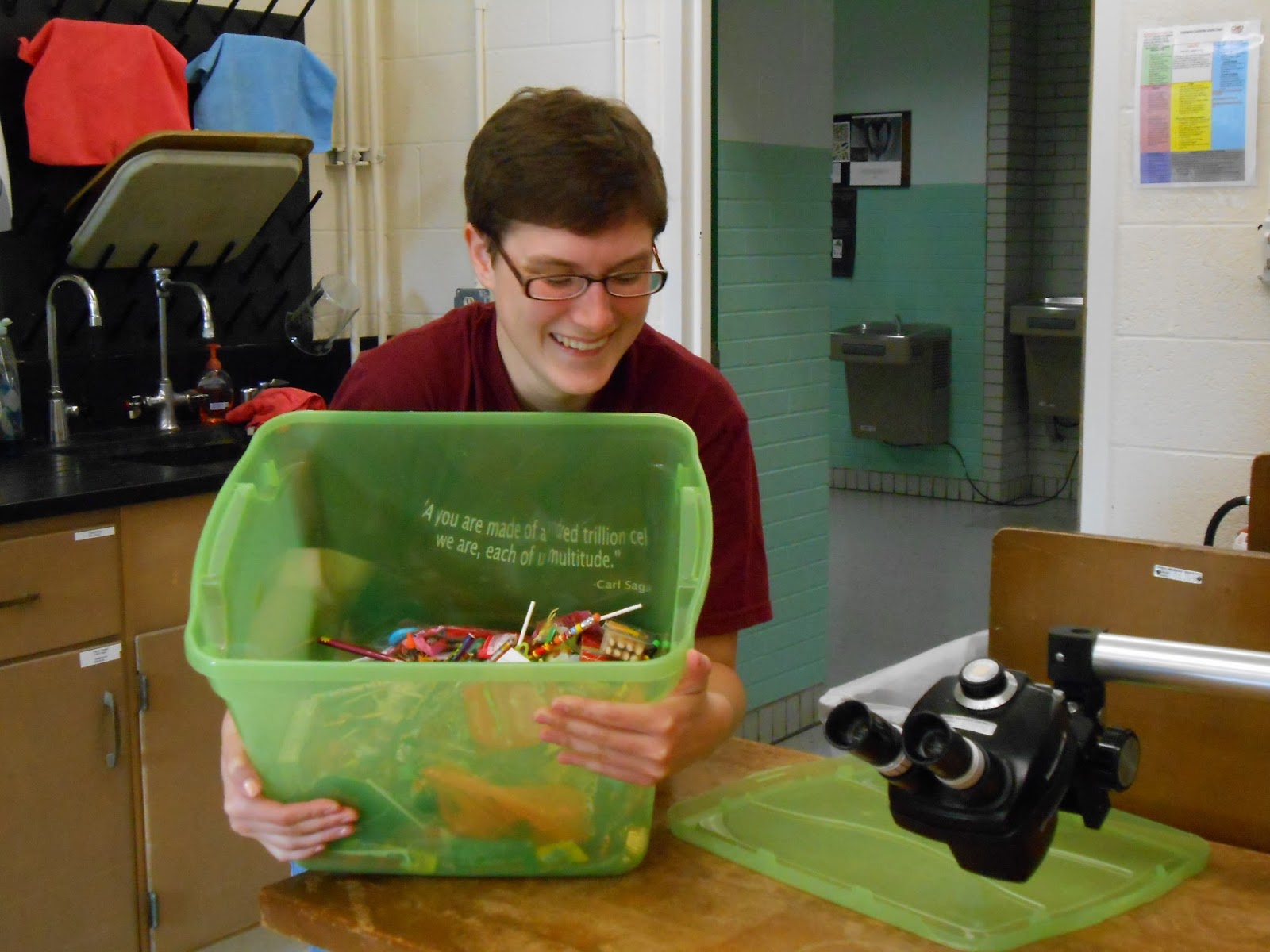
 What is most challenging about digitization is that it is repetitive and seemingly mindless…and yet it isn’t. We must still be vigilant, checking as we go for the little details on each specimen: accession numbers, folder organization, annotation accuracy, etc. We also have to try to keep track of barcode numbers, so that we don’t miss photographing or batching out any specimens. This work can be tedious, so to keep us motivated, Dr. Monfils has provided us with copious amounts of candy (beneficial for our mental sanity but not necessarily for our waistlines). We have also found that books on tape actually help keep us more focused, and prevent our eyes from glazing over after seven-plus hours of the same task. We take occasional stretch breaks, and Sascha and I make sure to take turns photographing and barcoding, lest we are driven mad by the job and are forced to become nomadic hermits on some misty Middle Earth mountain. Luckily, I became eccentric long before I began my work in the CMC Herbarium, and so I think I am less at risk than Sascha.


 So much candy! How to decide which to take?


 Maybe I'll just take them all...

We have twenty cabinets total, and last week, we made great progress. We barcoded five and a half cabinets of specimens and photographed three. If we keep going at this rate, we believe that we can finish barcoding the whole collection by the time Sascha leaves. We also hope to be at least half-way through digitizing the collection at that point. So, those are our longer-term goals…the longest being that the whole collection needs to be digitized by the end of the summer in August.

Our short-term goals for this week are as follows:
1)      Get through at least 6,000 barcodes
2)      Photograph at least 3,500 specimens (~700 a day over a five day work week)


We believe that these goals will drive us harder, but are also realistic to achieve. Posting them here also makes us accountable. So, we are depending on all of our blog followers to keep us on our toes!

Vigilance!

Abigail H.