Friday, June 29, 2012

Cabinet 1 is looking better everyday!

Hello plant lovers,

The past couple of weeks, I have been focusing on cataloging (or entrying data), annotating and organizing all of Cabinet 1! As mentioned before, our collection is being organized according to the the Edward G. Voss’ Michigan Flora 2nd edition which contains 3 volumes. However, these books do not include ferns and allies, therefore; we are organizing our fern cabinet according to the Angiosperm Phylogeny Group III System (http://www.mobot.org/mobot/research/apweb/).

Along our collection, we encounter different collored folders and specimens that need to be foldered correctly.

Did you know that there is a right way of foldering specimens in an Herbarium? Everything is well thought in the Herbaria world!

First we must have a genus folder:

Genus Folder (It is thicker than the rest)

Then, foldered in the opposite direction and inside the genus folder, we must have a species folder!

Genus and species folders are in opposite directions

Specimens Foldered correctly


This way the specimens are protected against external damage and are more easily to be handed!

Here is how cabinet 1 is looking like after we foldered all the specimens and labeled all the folders!


There is more room for improvement here, but I can help on feeling very well about this! I can't wait to have all of our 14 cabinets looking like this one!

Thank you!

Emilie


Friday, June 22, 2012

Annotating Specimens

Hello Everyone!

This week I focused on producing annotation labels and glueing them on specimens that had the scientific name and/or the family name changed.

According with Simpson (2010) on his book "Plant Systematics," an annotation label "verifies or changes the identity of a specimen or that documents the removal of plant material from the specimen." Also, everytime a researcher loans specimens from ah Herbarium and uses it for research, the specimen has to be annotated.

Usually, annotatioa labels are permanent and are glued above the standard Herbarium label. It is important that an annotation label contains the name of the herbarium, the name being changed (species, family or both); the name of who determined it and the determination source.

We started by annotating the specimens on our first cabinet. It contains our non-vascular plants, ferns and allies. Many of them were collected and indentified in the 60's , therefore lots of name changes (and annotations) had to be made!

Here are some pictures of the labels!

Annotation for a specific name change

Annotation for Family name change

I really enjoy checking name changes and annotating the specimens! I feel I am learning so much about plant taxonomy these days, and for me it is definetely the beggining of the realization of a goal I had for myself! Also, after annotating the entire cabinet 1, I think I am on my way to becoming a fern expert ;)

Thanks for reading!

Emilie

Reference Cited

Simpson, Michael George. Plant systematics. 2. ed. Amsterdam [u.a.: Elsevier Acad. Press, 2010.    Print.


Friday, June 15, 2012

Week 5: The Digitization Project

This was a very eventful week at the CMC Herbarium! The digitizing equipment is all assembled together and only a few adjustments are needed so it is ready to go!

Therefore, Anna had to go through a series of online meetings to learn how to operate and adjust the equipment. There are many steps that have to be followed in order to digitize specimens, so all of this seems very challenging to me. However, I am positive that after we get some practice the work is going to flow well, and honestly I can't wait to database our collection!

 Anna participating in a online meeting about the digitizing equipment.

 Taking trial pictures of specimens

 Testing the equipment

Barcodes like this one will be added to our specimens after they are digitized.

To learn more about the digitizing equipment used in our Herbarium, please visit the "Silver Biology Group" website: http://www.silverbiology.com/

However, finishing setting up the digitizing equipment was not the only thing we had to worry about this week. There are a few more things we had (and still have) to accomplish at the CMC Herbarium and we call it the "CMC Digitization Project": 1) Figure out how to organize the collection, 2) Check what materials we have in each cabinet to allow organization; 3) Double check family and species names of the specimens we currently have to check if any updates are needed; 4) Produce and attach annotation labels on specimens if needed.

I will comment on each topic in order,  

1. Right now, the specimen organization is based on the organization of Edward G. Voss’ Michigan Flora.  His system is based off of a natural system proposed by Adolf Engler in Die Natürlichen Pflanzenfamilien (The natural plant families), edited with Karl A. E. Prantl, 1887-1915. This system is commonly used is most large American herbaria. Using the Engler System, herbarium specimens are arranged by Family and then in alphabetical order by Genus and further by specific epithet.

If you want to know more about the advantages and disadvantages of both Systematic and Alphabetical arrangements of Herbaria, check our website below and click on "Filing in an Herbarium": http://cmcherbarium.bio.cmich.edu/collection_curation.html


2. At the Herbarium, we have cabinets that are used to store our collection and also research and classes collections. This week, I went through the research cabinets and took notes of what’s in them as well as pointed out which shelves were empty or underused (see pictured below). This process will give us an idea of how much free space we have in the Herbarium so we can better organize it.

Organization sheet 

 The idea is to go through the collection cabinets and do the same.


3. Do you remember that during weeks 2 and 3 I was cataloging the specimens we had in our collection cabinets? In 2 weeks I was able to list in a Excel spreadsheet all the specimens stored in our first 3 cabinets. This week, I had to double check the name of all families and species on Tropicos ( www.tropicos.org) so we can annotate the labels on our specimens.


4. I completed the process above for our 1st cabinet to have an idea of how long it takes me to do it. It takes me about 30-40 min to double check all the families and species we have in a cabinet but it is a very important process. We need to know the most recent names to the current families and species we have so we can generate a trustable database. Therefore, my next step was to make the annotation labels (yes, I know VERY exciting!!) for all the specimens that need one. Below is the annotation label template I created! I am very excited because my name will be on them, YAY!
Annotation labels

Wow, there was lot of work  to do this week but it is so worth it! Next week, the “Digitization Project” continues and will keep you updated on the news!!


Have a great day,

Emilie


Friday, June 8, 2012

Week 4: Work in Progress

This week I continued to catalog specimens and to list the links for various rare species!

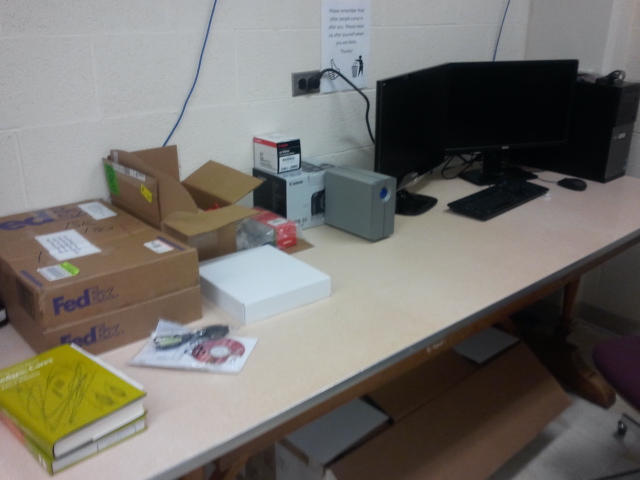
Meanwhile, boxes and more boxes arrived via mail containing computers, cameras and more electronic equipment!

The Biology Information and Technology Staff started to put the equipment together and this is how it looked in the beginning of the week:
1st of connecting the Digitazing equipment


By the end of the week, the equipment is almost ready to start the digitazation!

Digitazing Equipment set up


Thanks to Robert Devantier and assistants the digitazation of the CMC Herbarium is on its way to becoming a reality! Thanks for your efforts!

Emilie

Friday, May 25, 2012

Week 3: Listing Rare Plant Species Links

Hello all,


This week, besides continuing to catalog the Herbarium specimens, Anna introduced me to a new assignment. I started to organize a spreadsheet with the links for Michigan rare species profiles from various online databases available to the general public (yes, you can also access them!). Later on the list of links will be available at the MiCOB website ( http://www.micob.org ).


One of MiCOB's goals is to centralize the resources for Michigan rare plants so we can improve research and expand knowledge about them. Through the "Rare Plant Species Assignment," students come up with annotated bibliographies of rare plants in order to achieve this goal. You can read more at: http://www.micob.org/research.html
My job is to check which annotated bibliographies have already been made and provide the links for the plant profiles from the following databases:

This experience has been very valuable for me because I am getting familiarized with all these wonderful tools. Before that, I had little knowledge about such databases, and now I am able to navigate and properly search on them. It is highly recommended that students seeking a career in plant sciences get to know and explore these databases and make use of the information available to us. Instead of performing a general search about a certain plant, now I go directly to some of these databases to perform my search confident that I will obtain reliable information. This is useful for my work not only in the herbarium (checking name spelling of plants, changes in taxonomy, etc.) but also in the CMU Greenhouse were I have to provide accurate information about plant families and species to the public.

Overall, I was very excited about my task this week and looking forward to start databasing!

Have a great weekend,

Emilie

Friday, May 18, 2012

Week 2: Listing Herbarium Specimens

This week I started listing the specimens the CMC Herbarium currently possesses so that we can organize better and update label information.  I will be performing this task until our digitizing equipment is up and running!

I was able to list and verify 1175 specimens this week, and this is just one column of one of the many cabinets we have!
Cabinet 1

 It is very tiring job, but I enjoy it a lot because I get to look and analyze different plants as well as improve my plant taxonomy skills!

 One of the 1175 specimens I checked!
This experience exposed me to different types of specimens (old, new, well conserved, not very well conserved, etc.) and I already have some favorites, like the lady fern (Athyrium filix-femina) below!
Lady Fern
Thanks and happy weekend!

Emilie

Monday, May 14, 2012

3rd Annual Meeting of the Michigan Consortium of Botanists

Today, Anna, her graduate students Derek and Rachel, lab students Hillary, Jacob and Lissi, and I (Herbarium assistant) attended the 3rd Annual Meeting of the Michigan Consortium of Botanists at Hillsdale College!

The Meeting included talks by Ranessa Cooper (Hillsdale College), Anna Monfils (Central Michigan University), Tim Evans (Grand Valley State University), Catherine Yansa (Michigan State University) and Tony Reznicek (Univetsity of Michigan).

I particularly found the meeting very interesting because it emphasized the importance of digitization of small herbaria. I could understand a lot better the process and institutions involved in this initiative, which was essential for me because that is what I am going to be doing the whole summer!

I also got to know better how the Michigan Consortium of Botanists (MiCOB) is organized,  as well as their work and goals! I got very fascinated about it and I decide to join as a student representative! Hopefully, I will be able to help by analyzing the different subjects through a student perspective !

Check out MiCOB's website it is a great resource for Botanists in Michigan and the Great Lakes area:
http://micob.org/

Emilie